How to Start a Trucking Company in the USA: Step-by-Step Guide (2026)
· Trucking Compliance Service
The freight industry is the absolute backbone of the American economy. If you are transitioning from being a company driver to an independent owner-operator, or if you are an entrepreneur looking to build a lucrative fleet from scratch, the opportunities are massive.
However, figuring out how to start a trucking company in the USA involves much more than just buying a semi-truck and hitting the highway. The Federal Motor Carrier Safety Administration (FMCSA) and state transportation departments require a strict sequence of registrations, tax filings, and legal permits before you can legally haul your first load.
In this comprehensive 2026 guide, we break down the exact steps to launch your trucking business, stay 100% compliant, and start generating revenue without getting bogged down by bureaucratic red tape.
Step 1: Form Your Trucking Business Entity
Before you apply for any trucking permits, you must establish your business legally. Operating as a sole proprietor exposes your personal assets (like your house or personal savings) to massive liabilities if your truck is involved in an accident.
- Choose an Entity: Most successful owner-operators form a Limited Liability Company (LLC) or a Corporation. This separates your personal assets from your business liabilities.
- Get an EIN: Once your state approves your LLC, you must apply for an Employer Identification Number (EIN) from the IRS. You will need this to open a business bank account and file your highway taxes.
Step 2: Get Your USDOT Number and MC Authority
You cannot operate a commercial motor vehicle (CMV) without being registered with the federal government.
- USDOT Number: This is a unique identifier assigned by the FMCSA. It tracks your company’s safety record, compliance reviews, and crash investigations.
- Motor Carrier (MC) Authority: If you plan to transport federally regulated commodities across state lines (interstate commerce), you need an MC Number. This grants you the legal “Operating Authority” to haul freight for hire.
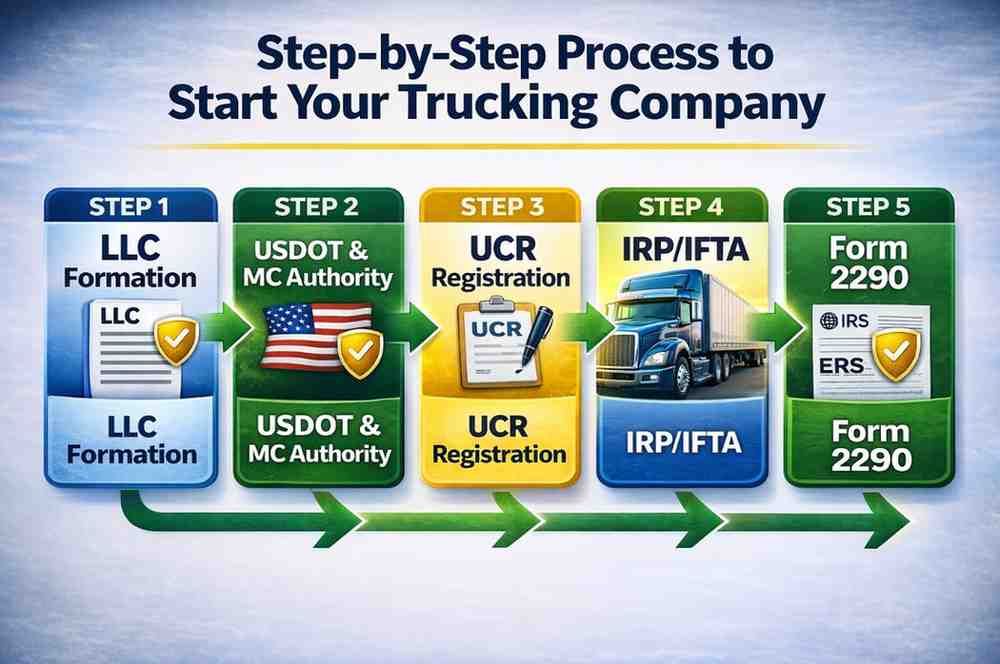
Step 3: Register for UCR (Unified Carrier Registration)
The Unified Carrier Registration (UCR) is a federally mandated, state-administered program. Any individual or company operating commercial vehicles in interstate or international commerce must register their business and pay an annual fee based on their fleet size.
Failing to file your UCR before crossing state lines will result in your truck being detained at weigh stations and hefty fines being issued to your new company.
Step 4: Set Up IRP and IFTA (International Fuel Tax Agreement)
If you are crossing state borders, you do not want to buy trip permits and fuel permits for every single state you enter. To simplify this, you need two critical setups:
- IRP (International Registration Plan): This gives you your “apportioned” license plate, allowing your truck to operate in all states and Canadian provinces. Your registration fee is divided among the states based on the miles you drive in each.
- IFTA (International Fuel Tax Agreement): This agreement simplifies the reporting of fuel use. You receive an IFTA license and decals for your truck. Instead of paying fuel taxes at every border, you file a quarterly IFTA report that calculates what you owe based on where you bought fuel and where you drove.
Step 5: File Your Heavy Vehicle Use Tax (Form 2290)
The IRS requires all heavy highway vehicles operating at a gross weight of 55,000 pounds or more to pay an annual tax.
Before you can get your apportioned IRP plates from the DMV, you must show proof that you have paid this tax by presenting a watermarked Stamped Schedule 1. You can learn exactly how to process this quickly in our Instant 2290 E-File Highway Tax Guide.
Step 6: Ensure CDL Protection and CARB Compliance
Once your paperwork is filed, your goal is to protect your new business. A single suspended license or emissions violation can bankrupt a startup trucking company.
- Protect Your License: As a new owner-operator, your CSA score is fragile. Ensure you have proper CDL protection to fight moving violations and keep your insurance premiums low.
- California Operations: If your routes will take you into California, you must register for the Clean Truck Check program. Read our complete CARB Compliance Trucking Guide to avoid thousands of dollars in state fines.
How Trucking Compliance Services Can Help You Launch
Figuring out how to start a trucking company in the USA can feel overwhelming. Dealing with the FMCSA, the IRS, and state DMVs takes you away from finding loads and negotiating rates.

At Trucking Compliance Service, we are your one-stop shop for launching your new fleet. We specialize in handling the entire bureaucratic maze from start to finish.
Our complete “New Carrier Setup” services include:
- Company Formation (LLC & EIN)
- USDOT Number & MC Authority Filing
- UCR Registration
- IRP Setup & IFTA Decals
- Form 2290 Filings
Stop stressing over government paperwork and start focusing on the road ahead. We get you fully compliant and ready to dispatch, fast.
Ready to start your trucking company?
Let our compliance experts handle your new carrier setup so you can start hauling legally and profitably.
Call: 916-866-2838
Website: truckingcomplianceservice.com
Frequently Asked Questions (FAQs)
1. How long does it take to get my MC Authority active?
Once you apply for your USDOT and MC numbers, there is a mandatory 21-day vetting and dispute period required by the FMCSA. During this time, you must also file your BOC-3 and have your insurance provider submit your active policies to the FMCSA. Most new authorities become active within 25 to 30 days.
2. Do I need an LLC to get a DOT number?
While you can technically apply for a DOT number as a sole proprietor, it is highly discouraged. Forming an LLC protects your personal assets from business liabilities, accidents, and lawsuits, which is crucial in the high-risk trucking industry.
3. What is the difference between UCR and IFTA?
UCR (Unified Carrier Registration) is an annual federal registration fee required for all interstate motor carriers based on fleet size. IFTA (International Fuel Tax Agreement) is a quarterly tax filing that calculates the fuel taxes you owe to different states based on the miles driven and fuel purchased in each specific jurisdiction.
Need help? Call 888-700-5704 or contact us.