What to Do If You Get a CDL Ticket (Step-by-Step Guide)
· Trucking Compliance Service
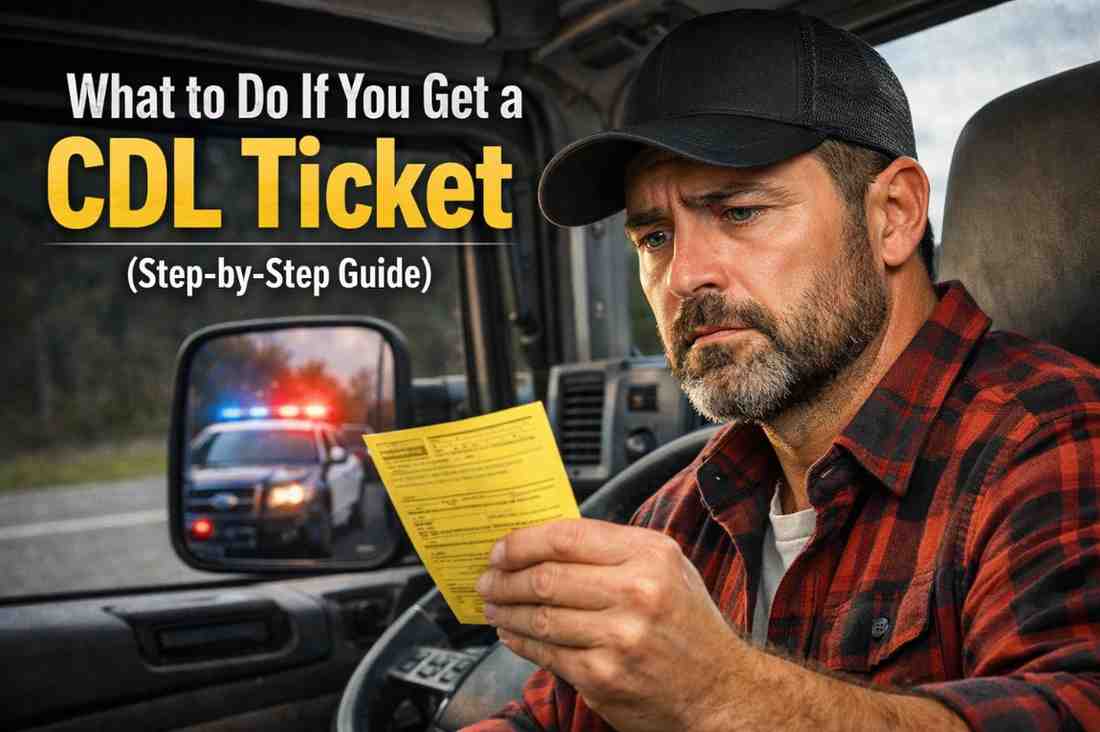
Seeing flashing lights in your mirror is every CDL driver’s worst nightmare. For a civilian driver, a traffic ticket is an inconvenience. For a commercial truck driver or owner-operator, a CDL ticket is a direct attack on your career, your business, and your financial future. The decisions you make in the next 24 to 48 hours after getting cited will determine whether that ticket costs you hundreds of dollars or tens of thousands over the next two years.
This guide walks you through exactly what to do — and what not to do — the moment you get a CDL ticket.
Step 1: Do Not Pay the Ticket
This is the single most important instruction in this entire guide. Do not pay the ticket. Not now. Not next week. Not ever, until you have spoken with a transportation attorney or a CDL protection specialist about your options.
When you pay a traffic ticket, you are making a legal admission of guilt. That admission is recorded on your Motor Vehicle Record (MVR) and reported directly to the FMCSA’s Safety Measurement System. It becomes a permanent part of your CSA score. It raises your commercial insurance premium at your next renewal. And it cannot be undone once the payment is processed.
Many truckers pay the fine because it feels like the easiest way to make the problem go away. It is not. It is the most expensive decision you can make.
Step 2: Understand What Kind of Ticket You Received
Not all CDL tickets carry the same weight. The FMCSA classifies moving violations into categories based on their severity, and the category of your violation determines how aggressively you need to fight it.
- Serious Traffic Violations: Speeding 15 mph or more over the limit, reckless driving, improper or erratic lane changes, following too closely, texting while driving, and driving a CMV without a CDL. Two of these within three years means a 60-day CDL suspension. Three means 120 days.
- Major Offenses: DUI, leaving the scene of an accident, using a CMV to commit a felony. First offense means a one-year CDL disqualification. Some offenses result in lifetime disqualification.
- Standard Moving Violations: Minor speeding, improper turns, failure to obey traffic signals. These still add points to your MVR and CSA score and raise your insurance rates even if they do not trigger automatic suspensions.
Every single category is worth fighting. The outcome of that fight is what separates truckers who keep their business profitable from those who watch their costs spiral out of control.
Step 3: Document Everything About the Stop
While the details are still fresh, write down everything you remember about the traffic stop. This information is critical for any attorney who takes your case:
- The exact date, time, and location where you were stopped
- Road conditions, weather, visibility, and traffic at the time
- What the officer said to you and exactly what you said in response
- Whether the officer used a radar gun, laser device, or paced your vehicle
- The position of the officer’s vehicle when they first observed you
- Any signage that was missing, obscured, or unclear
- Your ELD data and GPS tracking for the time of the stop
- Any dashcam footage that captured the incident
Dashcam footage in particular is extremely valuable. If you do not already have a dashcam on your truck, getting one should be your next investment after resolving this ticket.
Step 4: Notify Your Employer If You Drive for a Fleet
Under FMCSA regulations, you are legally required to notify your employer within 30 days of any traffic conviction in any vehicle — commercial or personal. This is not optional. Failure to notify your employer is itself a violation that can result in disqualification.
Note that you are required to report convictions, not citations. A citation that is later dismissed or reduced does not require reporting. This is one of many reasons why fighting the ticket matters.
Step 5: Contact a CDL Protection Specialist Immediately
The window for the best possible outcomes closes quickly after a citation is issued. Courts have deadlines, prosecutors have case loads, and the earlier a defense attorney engages on your case, the more options they have available.
A qualified transportation attorney can pursue several outcomes depending on the specifics of your case:
- Full dismissal: If there were procedural errors in the stop, calibration issues with the officer’s equipment, or factual inaccuracies on the citation, the ticket can sometimes be dismissed entirely.
- Reduction to a non-moving violation: In many jurisdictions, prosecutors will agree to reduce a moving violation to a non-moving violation such as a faulty equipment charge. A non-moving violation carries zero CSA points and does not affect your MVR.
- Deferred disposition or diversion: Some jurisdictions offer programs that keep the conviction off your record if you meet certain conditions. Note that CDL holders are excluded from traffic school and defensive driving course options in most states due to federal anti-masking laws.
What a CDL Ticket Actually Costs You If You Do Nothing
Most drivers think about a ticket in terms of the fine amount. The fine is the least expensive part. Here is what paying a ticket actually costs an owner-operator over time:
- CSA score increase: Points stay on your record for 24 months at maximum weight for the first year. During that entire period, you face higher broker scrutiny and more frequent inspections.
- Insurance premium increase: A single serious moving violation can raise your annual commercial insurance premium by $3,000 to $8,000 or more. That increase persists for as long as the violation stays on your MVR — typically three years.
- Lost freight opportunities: Premium shippers and brokers use automated compliance screening. Carriers with elevated CSA scores are filtered out before loads are even offered.
- Potential CDL suspension: If this is not your first violation in the past three years, you may already be one citation away from a mandatory suspension.
The math is straightforward. A $400 speeding ticket that you pay without fighting can easily cost $15,000 to $25,000 over the following three years when you account for insurance increases and lost freight revenue alone.
CDL Protection: The Smartest Investment an Owner-Operator Can Make
The most financially successful owner-operators treat their CDL the same way they treat their truck — as a business asset that requires active protection and maintenance. A CDL protection plan connects you with experienced transportation attorneys who fight your violations so you do not have to take days off work to appear in distant courtrooms.
At Trucking Compliance Service, our CDL protection specialists are ready to evaluate your ticket and connect you with the right attorney for your jurisdiction. We have helped hundreds of owner-operators avoid CSA points, protect their insurance rates, and keep their licenses clean.
Got a ticket? Call us right now before you pay anything: 916-866-2838
Visit truckingcomplianceservice.com/cdl-protection to learn more about our CDL protection plans.
Frequently Asked Questions
1. Can I use traffic school to remove a CDL ticket from my record?
No. Federal anti-masking laws prohibit states from allowing CDL holders to use traffic school, defensive driving courses, or deferral programs to mask or remove moving violations from their commercial driving record. The only legitimate ways to keep a violation off your record are to have the case dismissed or reduced before conviction, or to successfully challenge the violation through a DataQ challenge if it was incorrectly entered by an officer.
2. Do I have to report a CDL ticket I got in my personal vehicle?
Yes. FMCSA regulations require CDL holders to report all traffic convictions to their employer within 30 days, regardless of which vehicle they were driving at the time. Additionally, serious violations in a personal vehicle — such as DUI — carry the same CDL disqualification consequences as violations in a commercial vehicle.
3. How long does a CDL ticket stay on my record?
Moving violations typically remain on your state Motor Vehicle Record for three years from the conviction date. The FMCSA keeps violation data on your public CSA Safety Measurement System profile for 24 months, with the heaviest point weighting applied during the first 12 months. Major offenses such as DUI convictions may remain on your MVR for significantly longer depending on your state.
Need help? Call 888-700-5704 or contact us.