CARB Clean Truck Check Q4 2026: Deadlines Carriers Miss
· Trucking Compliance Services
Prefer to watch? The 1-minute version
Video transcript
If you run a diesel truck into California, you might owe a Clean Truck Check test this quarter — even from out of state. Most diesel trucks over 14,000 pounds that operate in California must register and test, no matter where your company is based. Newer OBD trucks get checked remotely every 90 days. Older non-OBD trucks need an in-person smoke test every 6 months. Miss your window and CARB can flag you non-compliant, letting DMV hold your registration renewal. A held registration can get your truck pulled out of service at roadside, adding a CSA violation and costing real revenue. Regularly hauling into LA, Oakland, or the Central Valley puts you in scope, even with an out-of-state DOT number. Need help with this? Trucking Compliance Services can handle it for you. Call 888-700-5704, or get your free DOT compliance check at truckingcomplianceservice.com.
If you run a diesel truck in California — even if your company is based in another state — you may owe a Clean Truck Check test this quarter. CARB (the California Air Resources Board) requires most heavy-duty diesel vehicles to pass an emissions test on a recurring schedule, and missing it can put a hold on your DMV vehicle registration. This guide explains who must test, how often, what it costs, and what to do if you're behind.
What is CARB Clean Truck Check?
Clean Truck Check is California's statewide emissions testing program for heavy-duty vehicles. It replaced the old Periodic Smoke Inspection Program (PSIP) and now requires most diesel trucks over 14,000 pounds GVWR (gross vehicle weight rating) that operate in California to report into CARB's online system and pass a test.
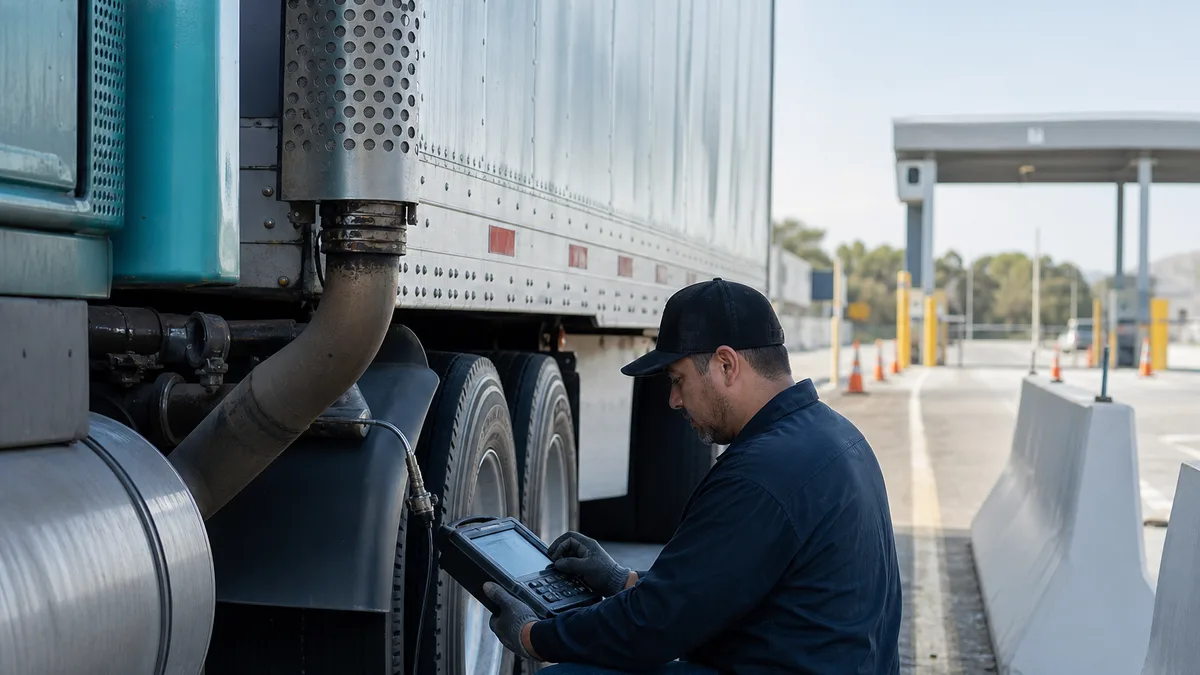
The program applies to trucks based in California and to out-of-state trucks that travel into California regularly. If your truck has an engine model year 2013 or newer with onboard diagnostics (OBD), CARB can often pull emissions data remotely. Older trucks without OBD typically need an in-person opacity (smoke) test from a CARB-recognized tester.
Who has to test, and how often?
Most affected trucks test either every 90 days (quarterly) or every 6 months, depending on engine model year and OBD capability. Newer OBD-equipped trucks are generally tested quarterly through remote data pulls; older non-OBD trucks are tested twice a year with an in-person smoke test.
Because the schedule depends on your specific VIN (vehicle identification number) and engine year, don't guess — log in to CARB's Clean Truck Check portal (ww2.arb.ca.gov) with your vehicle information to see your exact due date. CARB assigns a testing window, and you'll get a compliance deadline tied to your DMV registration renewal date.
| Vehicle type | Typical testing frequency | Test method |
|---|---|---|
| Newer OBD-equipped diesel trucks | Every 90 days | Remote OBD data check |
| Older non-OBD diesel trucks | Every 6 months | In-person opacity (smoke) test |
| Gasoline/alternative fuel heavy trucks | Check portal for requirement | Varies |
What happens if I miss a Clean Truck Check deadline?
If you miss your testing window, CARB can flag your vehicle as non-compliant, and the California DMV can place a hold on your vehicle registration renewal. That means you cannot legally renew your plates until the test is completed and the result is reported into the Clean Truck Check system.
A registration hold is more than paperwork. A truck with expired or held registration can be placed out of service at a roadside inspection, which adds a violation to your CSA (Compliance, Safety, Accountability) record and can trigger fines. For a small fleet, one truck sitting out of service for days while you sort out testing can mean real lost revenue.
How much does Clean Truck Check testing cost?
Testing fees vary by tester, test method, and whether you use CARB's own compliance fee structure or a private testing service. Because CARB updates fee schedules periodically, check the current amount directly on CARB's Clean Truck Check page (ww2.arb.ca.gov) before budgeting, rather than relying on an old number.
In general, OBD-based remote checks tend to cost less than in-person opacity tests, since no technician visit is required. Some carriers also pay a compliance fee when they register their fleet in the CARB portal, separate from any per-test charge. Build both into your maintenance budget so a surprise invoice doesn't catch you off guard.
How do I register my trucks in the Clean Truck Check system?
You register your fleet directly through CARB's online Clean Truck Check portal using your company information and each vehicle's VIN. Once registered, CARB tracks your testing schedule and sends compliance reminders tied to each truck.
- Go to CARB's Clean Truck Check portal on ww2.arb.ca.gov and create or log in to your account.
- Add each vehicle by VIN, engine model year, and GVWR.
- Confirm whether each truck needs OBD reporting or an in-person smoke test.
- Schedule the test with a CARB-recognized testing provider if an in-person test is required.
- Make sure results are reported into the system — don't just keep a paper receipt.
- Check your compliance status before every DMV registration renewal.
Does Clean Truck Check apply to out-of-state carriers?
Yes. If your truck regularly travels into California, CARB can require it to be tested even if your business and DOT (Department of Transportation) number are based elsewhere. This is one of the most common surprises for small fleets that haul into Los Angeles, Oakland, or the Central Valley on a regular lane.
Out-of-state carriers often don't realize they're in scope until a registration renewal gets rejected or a roadside inspection flags the issue. If California is a regular part of your routes, it's worth checking your trucks against CARB's requirements now, before Q4 testing windows close and before 2027 registration renewals come due.
How TCS can help
Clean Truck Check is just one piece of California compliance, and it's easy to lose track of testing windows alongside UCR (Unified Carrier Registration), IFTA, IRP, and your MCS-150 updates. Trucking Compliance Services helps owner-operators and small fleets — in California and nationwide — stay on top of every deadline so one missed test doesn't turn into a parked truck.
Run a free DOT compliance check at https://app.truckingcomplianceservice.com/check to see where your fleet stands, or call us at 888-700-5704. You can also reach our team through our contact page if you have questions about California-specific requirements.
This article is general information, not legal or tax advice. Check with CARB, the California DMV, or a qualified professional for guidance specific to your fleet.
Last updated: October 31, 2026
Frequently asked questions
Who must comply with CARB Clean Truck Check?
Most diesel trucks over 14,000 pounds GVWR that operate in California, including out-of-state trucks that regularly travel into the state, must register and test under Clean Truck Check.
How often do I need to test my truck?
It depends on your engine's OBD capability and model year — newer OBD-equipped trucks are typically checked every 90 days, while older non-OBD trucks usually need an in-person smoke test every 6 months. Check CARB's portal for your exact schedule.
What happens if I miss my Clean Truck Check test?
CARB can flag your vehicle as non-compliant and the California DMV can place a hold on your registration renewal, which can lead to an out-of-service order at a roadside inspection.
Does Clean Truck Check apply if my company isn't based in California?
Yes. If your truck regularly operates in California, CARB can require testing regardless of where your business or USDOT number is registered.
Where do I check my truck's exact testing deadline?
Log in to CARB's Clean Truck Check portal on ww2.arb.ca.gov with your vehicle's VIN to see your assigned testing window and compliance status.
Sources
Need help? Call 888-700-5704 or contact us.